New Things Thursday!

So after my last post I started to have a crisis of confidence in what I was planning to do. I felt like I oversold my plans a bit too much. What if this is a complete disaster? I’ve kind of committed to blogging about it now!

Thankfully it seemed to go well, and the feedback I got from the students was really positive.

So anyway, introducing…
(drum roll, drawing out the tension, not really a surprise since it’s in the title…)

New Things Thursday Powerpoint slide I used to introduce ‘New Things Thursday’.

So this is the idea – Thursdays are now all about ‘new things’. As I wrote last time, I want to capture the excitement of discovery that I see in maths but seems to go unnoticed by students. By putting the idea that this is something new front and center, I’m hoping I can sidestep that part of a kid’s brain that tells them each lesson is just the same old boring maths.

So I’m putting these rules on myself for Thursdays. That said, I’m completely prepared to break these rules I feel the need to. And given that New Things Thursday is itself a new thing, it may need to change.

Rules for New Things Thursday

  • Each lesson will be about on something new. A new rule, a new concept, a new perspective, whatever. We will still do some revision, and the new content will build on what the students already know, but the ‘new thing’ will be the focus of the lesson.

  • Rather than explicitly telling students the new thing, I will find a way to let them discover it themselves. This will be a challenge, as it will take a lot longer to introduce each idea, but hopefully it leads to more solid understanding from the start.

  • For each ‘new thing’, students will create a ‘new thing page’: a page in their workbooks that summarises the new content. This page will be their main reference to the concept in future lessons.

To set the tone of New Things Thursday, I’m also allowing students a few minutes where they can share with me and the class any ‘new things’ that they’re excited about, which can be whatever they’re interested in and doesn’t even need to relate to maths. (I realised afterwards that I may have subconciously ripped this idea off from Sarah Hagan’s Good Things Mondays, so thanks goes her. Actually, most of elements of New Things Thursday are probably stolen from other bloggers.)

The first New Thing: Pythagoras’ Theorem

Introducing Pythagoras is always an interesting moment; it’s one of those key points where high school maths transitions from being ‘arithmetic’ to ‘mathematics’, and might even be the first time students hear the word ‘theorem’.

The statement of rule (a2 + b2 = c2) is so simple to students that they don’t always recognise the significance of it, and unfortunately it is often only treated as a tool for calculating lengths. I think our aim should be to helps students realise the surprising elegance of the theorem, the mathematical truth it reveals.

We started the lesson talking about square numbers and I asked why they were called ‘square’ numbers. It took a little prompting, but they realised that they relate to the area of squares. I had them list all of them from 12 to 202, which didn’t take too long. Once they had their lists, I pointed out that 144 + 25 = 169, or 122 + 52 = 132.

I asked if they could find any more combinations like it, and gave them a few minutes in groups to see how many they could find. (I deliberately didn’t use 32 + 42 = 52 as my example so they would have an easier one to find.) A few students asked me whether the ones they’d found were correct. I told them they didn’t need to check with me – they could check themselves using their calculator.

I then listed the combinations on the whiteboard. Some had found up to 82 + 152 = 172. Some had realised that many were multiples of 32 + 42 = 52. (YES!) I had each student choose one equation from the board, and asked them to cut out three squares representing the numbers in their equation from grid paper that I had handed out.

Notice that so far I have not mentioned triangles or right-angles, or even the name Pythagoras. That was the secret truth that I wanted my students to discover.

I asked them to create a triangle by using the edges of their squares. What sort of triangle was it? It turned out they all had right angle triangles!

It was at this point that I finally put up some notes about Pythagoras’ theorem, and had them create their new things page. I’d already prepared one myself in case any students didn’t know what to put on theirs:
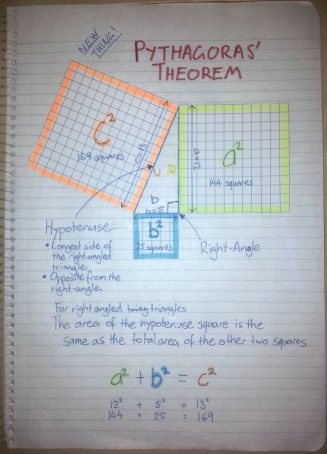
My new thing page! Sorry I'm not that artistic...

Thankfully a lot of of the pages the class made looked a lot better than mine. Some students even decided to create a ‘new things’ section in their book so it would be easier to look up in the future.

I pointed out that though we’d discovered this pattern, it’s not really a theorem until we prove it – which hopefully will happen next lesson.

Unfortunately, that was the last Thursday I’ll have them this term – they have an excursion next week and I have one the week after. But I think I’ve built some enthusiasm from the class for ‘new things’, and set a pattern we can start in earnest next term. And anyway, there’s no reason I can’t do this:

New things Friday!


New things

New things are awesome. New things get people excited. There’s nothing quite like the feeling of discovery or of experiencing something different. Just off the top of my head I can think of these things that are new for me in the last 6 months, that had/have me excited:

  • I started bike riding! (and now I’m at least moderately fit!)
  • I bought a Surface Pro 2! (I’m a gadget nerd, sorry)
  • I grew a beard! (though I’m thinking it’s time for it to go)
  • I started this blog! (woo!)

I’m sure there’s some psychological explanation as to why the human mind likes to explore the new and different, but to me it can be simply stated as this: New things are awesome!

Isn’t teaching all about new things? Isn’t it about giving students new ideas, new ways to think about the world, new perspectives on what they thought they already knew? Giving students the tools to create their own new things?

So here’s the big question: How do we get students excited about the new things we’re teaching them?

So many students enter our classrooms not expecting anything exciting. It wouldn’t be unusual to hear a student describe our lessons as the “same old boring maths”. It would be unreasonable for me to expect my students to be as excited about maths as I am, but I am teaching them new things. Surely I can get them a little bit excited about that?

I don’t have an answer, but I might have an idea. This week I plan to begin a unit on Pythagoras’ Theorem with my Year 9 class. Importantly, this will be the first time they’ve ever seen it. I have an opportunity to introduce a completely new thing to them. My aim is to make it clear to the class that this is a new thing, a new way to see the world, a new secret that’s been hiding in front of them ever since they learned what a triangle is.

Will my entire class be forever excited about maths from one lesson? Of course not, and I’m under no illusions of that either. Will a few of my students be a little more interested as a result? Maybe. I think it’s worth a try.

I’m not quite prepared to share my ideas yet – I’m not even convinced my students will go for it (though if any class is going to, it’s probably this one). Our next lesson is on Thursday, so hopefully I’ll share more after then.


Changes are coming

So if you’ve missed it (which is pretty likely unless you happen to be a Victorian maths teacher), a consultation period for the new VCE Mathematics study design has just begun. You can find info on any of the maths study pages on the VCAA website. They have a draft of the new study design to start in 2016. That means the current 2006 study design will last ten years once we’re done with it. So it’s probably due for a refresh.

It’s probably a good idea to go read the new study design in detail so you can give an informed opinion in the online questionaire they have. Instead, I’m just going to glance at the changes and just blog about my gut reactions.

The only VCE maths I’ve taught is Methods Unit 3 & 4 (and for the last few years at that), so most of my comments will focus on it.

Also, if it isn’t clear, the new study design is only a draft. So don’t go crazy about it yet.

No more “(CAS)”

“Mathematical Methods (CAS)” is dead! Long live “Mathematical Methods”!

By that, I mean they’ve dropped “(CAS)” off the name of the subject. Which totally makes sense, really, since it’s been our only “Methods” for a while now.

For context, a while ago (2004ish? When I was at school still, anyway) CAS calculators were introduced into the curriculum by adding “Mathematical Methods (CAS)” in parallel with “Mathematical Methods”. But then the original was killed off a few years ago, leaving us with only one Methods subject with “(CAS)” tacked on the end.

Statistics!

OK, I might have gone on record recently stating I’ve never really liked stats, but I’ve always thought it an odd omission not having statistics in Methods. But it’s there now: Area of Study 4 is now “Probability and Statistics”. Specifically, Statistical Inference is added, following on from Discrete and Continuous Probability Distributions.

Not only that, but Specialist Mathematics now has a “Probability and Statistics” area of study too. It’s been strange that up to this point, the only way to study statistics in Year 12 was in Further Mathematics, which not many of our high achieving maths students would do (though I hear there’s also a lot of stats in Psychology).

Of course, to make room for all the lovely new stats, something else has to give …

Where’s my matrices at?

So the list of topics removed from Methods includes:

  • Markov chains/sequences and transition matrices
  • matrix representation and solution of simultaneous linear equations

And while not in the official list of changes, I can’t find any mention of transformation matrices in the draft either. While this makes me somewhat sad (I loved linear algebra at uni) it’s somewhat understandable. The old treatment of matrices was a little unusual: we had to explain what they were for these three tiny parts of the course, but there was never really room for proper coverage of them.

Though I have one concern over their removal, from my personal experience. I went to school in Victoria and got my VCE, but I went to univeristy in South Australia. My very first lecture freaked me out – it was on matrices, and I had absolutely no idea what they were! I borrowed a SACE maths textbook from the library and got myself caught up pretty quickly, but by removing matrices from VCE again, are we making this situation possible once more?

As far as I can tell, the only mention of matrices in the draft is in General Maths. My small school isn’t big enough to run multiple General classes, so we usually only use it as a feeder into Further, so we’d be unlikely to cover matrices at all.

Honestly, the other removals from Methods seem sensible to me: topics that are interesting, but probably not essential when you’re trying to trim down a subject.

No more tests!

There are only three SACs set down for Methods now:

  • One “Application Task” over 1-2 weeks in Unit 3.
  • Two “Modelling or problem solving tasks” (the old Analysis tasks, probably) in Unit 4.

Missing are the two tests from Unit 3. Of course, there’s nothing stopping a teacher from setting their own non-graded tests, revision quizzes, or whatever you want to call them. My students are going to hate me…

New subject!

Specialist Mathematics Unit 1 & 2 is now a thing. I don’t really have anything to say about that yet.

There’s also got to be other changes I haven’t even noticed yet. I’ve already written a lot more than I intended, so I’ll leave it here for now. Again, these are just my first reactions, I might completely reverse my opinions in the coming days. If you’re a VCE maths teacher (or English for that matter, I think they’re being reviewed too) don’t forget to look through the draft yourself.


What if only one side of the earth faced the sun…

Today my VCE Unit 3/4 Maths Methods class was preparing for the test we have tomorrow, but we became distracted for a while. At the time I was disappointed in myself for letting that happen, but reflecting on it now, I’m actually pretty excited about it. Let me explain.

We were talking about circular functions, reviewing how to determine maximums and minimums, as well as sketching their graphs, just by looking at the functions. I mentioned that we’d seen a lot of functions that look like sin(π•t/12), which they realised related to cycles with a 24 hour period (hooray!). So far, still relevant.

Then one of my students mentioned that they’d seen a lot of questions about tides, but we remembered that tides have a period of 12 hours. That led us to talking about why, which led to talking about the Moon’s motion around the Earth, which led to me mentioning that the Moon is tidally locked with the Earth (that is, we only ever see one side of it).

Which led to someone asking this question:

What would happen if the Earth was tidally locked with the Sun?

So we talked about this for a while, and decided:

  • Each side of the Earth would be uninhabitable for being too hot or too cold. But hopefully there would be a zone in between which could sustain life (which would be in some kind of permanent sunrise/sunset).
  • Solar energy would be a lot cheaper and easier – solar panels could be in the sun all the time, and we wouldn’t have to change their direction.
  • We could build houses that rotated slowly so each side would get the same amount of sunlight. The rotating motors would be powered by our cheap solar energy.

This is where we ended the conversation, because we had revision to do, but I wish we could’ve kept going. Because what we had been doing really was maths in disguise. Well, kinda…

We had started with the statement “The Earth is tidally locked with the Sun” and followed that statement to a logical conclusion. We were thinking about the consequences of that statement in order to discover new truths. And isn’t that, if nothing else, what mathematics is?

Yeah, I know I’m stretching the definition of maths past the point of breaking here, but this is why I don’t think my ‘distraction’ was a waste of time. If we can teach a student to take an idea (be it mathematical or otherwise) and think “What if?”, isn’t a lot of our work already done?

I’m not suggesting we throw out our current curricula in favour of talking about silly ideas all lesson, and we did get back to sketching curves and differentiating functions pretty quickly (we have that test tomorrow, after all, not to mention the exams at the end of the year). I guess I’m just excited to have a class who’s willing to think through problems both creatively and logically, even if that means following Mr Carter on the “What if?” crazy-train every so often.

BTW: If you’re not already reading What If? by Randall Munroe (of xkcd fame), well, you should be.


Statistics Questions

I’ve never really liked statistics.

I know that’s a terrible thing to say as a teacher, but it’s true. Stats has always seemed too messy and too tedious to me. Compared with algebra, with it’s clear “it’s either proven or it’s not” results and elegant working, statistics is all over the place. (I majored in pure maths at uni, if you couldn’t tell).

But I think I’m actually starting to get a soft spot for stats now. I’ve realised something: statistics (and all maths and science, for that matter) is most interesting when it tells you something about the world that you didn’t realise before. Or maybe when it tells you something you already thought, but could never justify as true. I think I already knew this, but hadn’t bothered to actually put it into words before.

Statistics has a function that no other area of mathematics can really cover. Whenever we have a logical statement that we want to prove as true or false, algebra has our back. But for those questions that we don’t really know the answer to, that we have no real way of proving but want to have a crack at finding out anyway? Time to reach for the stats toolbox.

This is the key thing to convey to students about statistics – stats is how we answer those questions that seem, at first, unanswerable. So my Year 9 class started our statistics unit by asking a question. Learning from last year, I put a couple more restrictions on what the question could be:

  • The question had to be interesting. In my experience, some groups start with simple, obvious questions because it fits their need to complete any set task as quickly as possible. They don’t realise how bored they’ll be later in the project. I had to reject questions from a few groups, which annoyed them at the time, but I think their new questions were a lot more interesting.
  • No survey questions. I wasn’t letting my class interupt every other class in school. I think I was the most hated teacher in the staff room for a while last year.

So questions like “What’s the favourite AFL team of our school?” and “What type of music do teenagers like?” were out. These are the actual questions asked (and to be answered!) by our class:

  • Do pink marshmallows cook faster or slower than white marshmallows?
  • Does closing one eye affect the ability of a person to shoot a basketball or a netball?
  • Which types of biscuits go soggy in hot drinks first, and are they affected by adding milk?
  • What effect do TV shows and movies have on the heart rate of the viewer?
  • How is the cooling rate of boiled water affected by the container it’s kept in?
  • How do different web browsers (Chrome, Firefox, Internet Explorer) compare in terms of Javascript speed, when run on different devices?

(I apologise to any of my students if I got these wrong, but I wrote that list from memory.)

It was last week when they chose their questions. They performed their actual experiments today, and I’ll share a bit more about that once they’ve written up their projects.

But I’ll share one preliminary result: the heart rate group chose me as one of their test subjects. I really stood no chance keeping my pulse steady: they showed me a scene from Doctor Who. Not only that, but it was the Tenth Doctor’s regeneration!

Then they showed me a scene that I found out afterwards was from High School Musical. Let’s just say that my choice to never watch that movie was the right one.